
 Chinese
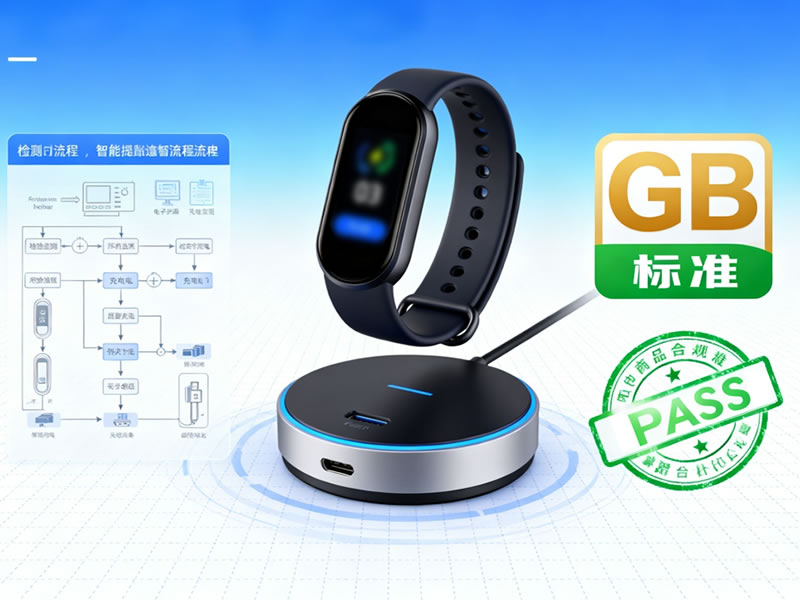
With the standardized development of the domestic electronic consumer market, new electronic products must undergo strict compliance testing before entering the market to ensure their quality, safety, and environmental performance meet the requirements of national mandatory standards. This article takes smart bracelets (including charging docks) as an example to detail the core compliance testing items, basis standards, and testing key points required for entering the domestic market, providing enterprises with clear compliance guidelines.
1. Basic Safety Testing: Ensuring Consumer Personal and Property Safety
Basic safety testing is the primary threshold for electronic products to enter the market. It focuses on evaluating the electrical safety performance of products under normal use and fault conditions, corresponding to the standard GB 4943.1-2022 "Information Technology Equipment - Safety - Part 1: General Requirements", which was enforced in 2023, replacing key test items in the old version.
Electric Shock Protection Test: Testing the product's enclosure protection level (IPXX), insulation resistance, and dielectric strength. For example, the smart bracelet charging dock must pass a dielectric strength test of AC 1500V (for 1 minute) to ensure no leakage risk during charging; the bracelet itself, which is in direct contact with the human body, must meet reinforced insulation requirements.
Fire and Overheating Protection: Evaluating the flame retardant grade of the enclosure material (such as V-0 grade) and the thermal stability of internal components. During the test, a charging overload scenario is simulated, requiring the product to work continuously for 1 hour under 1.2 times the rated voltage, with the enclosure surface temperature not exceeding 60°C, and no open flame or molten dripping.
Mechanical Strength Test: Aiming at the portable characteristics of smart bracelets, they must pass a 1.5-meter drop test (dropped onto hardwood boards) and a 10N static pressure test to ensure no cracks in the enclosure and no looseness in internal circuits.
Key Reminder: If the product contains lithium batteries (such as the built-in battery of a smart bracelet), it must additionally comply with GB 31241-2022 "Safety Requirements for Lithium-Ion Batteries and Battery Packs for Portable Electronic Products", with test items including abuse scenarios such as overcharging, over-discharging, short-circuiting, and挤压 (squeezing).
2. Electromagnetic Compatibility (EMC) Testing: Avoiding Interference with Other Electronic Devices
Electromagnetic compatibility testing ensures that products work normally in the electromagnetic environment and do not interfere with surrounding devices. The core standards are GB/T 9254-2021 "Radio Disturbance Limits and Measurement Methods for Information Technology Equipment" and the GB/T 17626 "Electromagnetic Compatibility - Testing and Measurement Techniques" series standards.
Electromagnetic Radiation Disturbance (EMI)
Test frequency range: 30MHz-1GHz
Limit requirement: Quasi-peak ≤54dBμV/m (30-230MHz), ≤51dBμV/m (230-1000MHz)
Testing key points: The Bluetooth module of the smart bracelet needs to focus on controlling radiation spurs to avoid interfering with mobile phones, Wi-Fi and other devices.
Electromagnetic Immunity (EMS)
Electrostatic Discharge (ESD): Contact discharge ±6kV, air discharge ±8kV
Radio Frequency Radiation Immunity: 80MHz-1GHz, field strength 10V/m
Testing key points: During the test, the product must maintain a stable Bluetooth connection, normal screen display, and no crash or data loss.
3. Environmental Compliance Testing: Responding to New Regulations on Hazardous Substance Control
Domestic environmental protection standards were further upgraded in 2025, with the core basis being the "Administrative Measures for the Restriction of the Use of Hazardous Substances in Electrical and Electronic Products" (RoHS 2.0) and the新增 (additional) control requirements in 2025, increasing the types of hazardous substances under control from 6 to 10.
Controlled Substances | Limit Requirement | Test Samples |
|---|---|---|
Cadmium (Cd) | ≤0.01% (100ppm) | Battery positive and negative materials, circuit board solder |
Lead (Pb), Mercury (Hg), Hexavalent Chromium (Cr⁶⁺) | ≤0.1% (1000ppm) | Enclosure plastic, metal connectors |
Phthalates (DEHP, BBP, DBP, DIBP) | Each substance ≤0.1% (1000ppm) | Smart bracelet strap (PVC material), charging cable outer skin |
The testing method adopts the GB/T 39560 series standards (equivalent to IEC 62321), and the product needs to be disassembled for testing to ensure each homogeneous material meets the limit. At the same time, the product must be labeled with a QR code in accordance with the requirements of SJ/T 11364-2024, linking to the hazardous substance information table (which must be kept for 5 years after the product is discontinued).
4. Energy Efficiency and Resource Recycling Testing: Responding to Green and Low-Carbon Policies
Although smart bracelets are not yet included in the national mandatory energy efficiency label catalog, they must comply with the standby power consumption requirements (≤0.5W) in GB 24850-2013 "Limited Values and Energy Efficiency Grades for Energy Efficiency of Flat Panel Televisions". The energy efficiency of the charging dock must meet GB 19054-2023 "Limited Values and Energy Efficiency Grades for Energy Efficiency of Charging Equipment for Portable Electronic Products", and the energy efficiency grade must reach level 2 or above.
In terms of resource recycling, the product must comply with the disassembly requirements of GB/T 26572-2011 "Limit Requirements for Restricted Substances in Electrical and Electronic Products". The battery must be designed as a detachable structure (or provide professional disassembly guidelines), and the packaging materials must meet:
Using recyclable materials (such as corrugated cardboard, recycled plastic), accounting for no less than 85%;
Prohibiting non-degradable plastic foam, and giving priority to corn starch-based buffer materials;
Marking the recyclable logo (GB/T 16716) and environmental certification logo.
5. Case Testing Process and Cycle
Sample Preparation: Provide 3-5 complete products (including accessories), as well as product manuals, BOM lists, and circuit schematics;
Project Testing: Safety testing (5 working days) → EMC testing (3 working days) → Environmental testing (7 working days) → Energy efficiency testing (2 working days);
Report Issuance: Issue a CNAS-accredited test report within 5 working days after the test is completed, supporting CCC certification application (if the product is in the CCC catalog, such as the charging dock of the smart bracelet belonging to "external power adapters for household and similar electrical appliances", additional CCC certification testing is required).
6. Advantages of Customized Testing Services
As a professional testing service company, we can provide customized solutions according to product characteristics:
Pre-test Service: Identify non-compliance risks of products in advance to avoid formal test failure;
Standard Interpretation: Track policy changes such as the 2025 RoHS new regulations and EMC standard updates in real time;
Full-process Guidance: Assist enterprises in completing sample rectification, certification application, and logo labeling to shorten the market entry cycle.